

A freshman at Seoul National University’s College
of Dentistry — one of the most competitive programs
in South Korea — just pulled back the curtain on
what it actually takes to get in.
The answer is both fascinating and deeply troubling.
Meet the Student From Daechi-dong
Daechi-dong is a neighborhood in Seoul’s Gangnam
district. If you know anything about South Korean
education, that name alone tells you everything.
Daechi-dong is ground zero for South Korea’s
private tutoring industry — a maze of cramming
academies (called “hagwons”) that line every
street, stacked floor after floor in every building.
The student, identified only as “A,” grew up there.
And in a YouTube interview, they laid out exactly
what that meant financially — and physically.
The Numbers Are Staggering
Elementary through middle school:
- 4 days per week at hagwons covering Korean,
English, math, physics, and chemistry - Spare time between classes filled with swimming,
basketball, and boxing - Monthly cost: already significant
High school years 1-2:
- Korean, math, English, science, Japanese hagwons
- Plus study room fees, textbooks, and online courses
- Monthly spend: approximately 4 million won (~$2,900 USD)
High school year 3 — the final push:
- Math: 3 hagwons
- Korean: 2 hagwons
- English: 1 hagwon
- Life Science: 2 hagwons
- Earth Science: 1 hagwon
- Total: 9 separate tutoring academies simultaneously
- Weekly hagwon hours: approximately 40 hours
- Monthly cost during “final period” (2 months before
the CSAT exam): over 5 million won (~$3,600 USD)
For context: the average monthly salary in South Korea
is approximately 3.5 million won.
This student’s exam prep alone cost more per month
than most Korean adults earn.
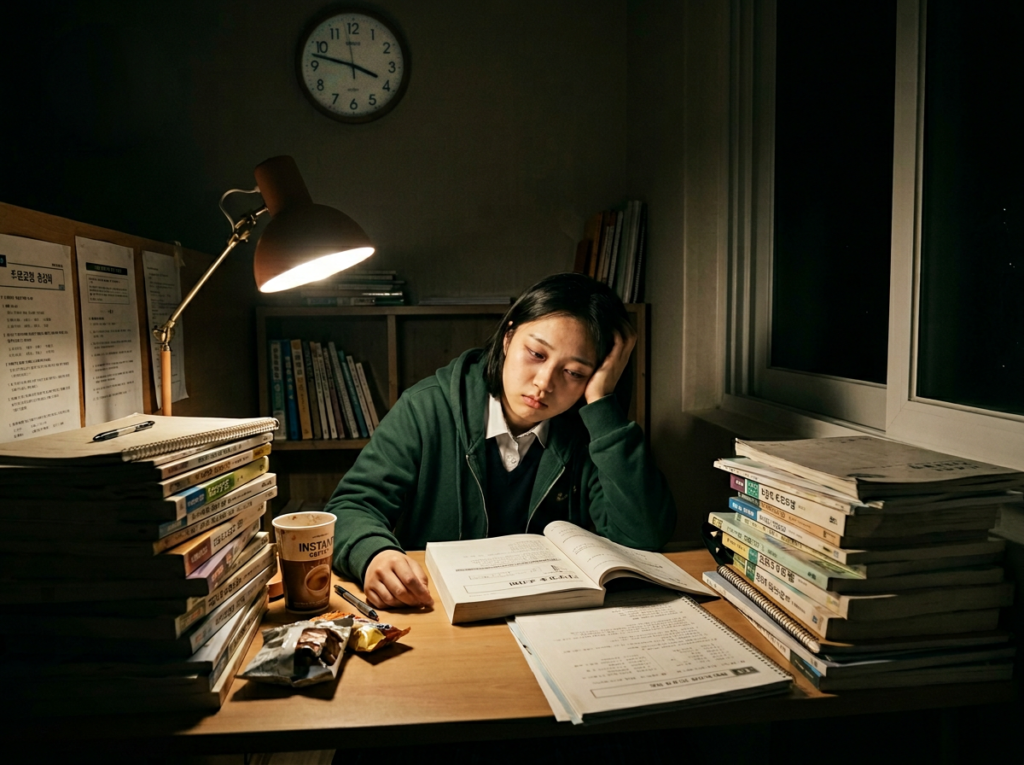
The Sleep Schedule Is Alarming
Here’s where it stops being about money
and starts being about survival.
During the most intense periods of study,
“A” described going to bed at 4 AM and
waking up at 7:20 AM — three hours and
twenty minutes of sleep — to make it to school on time.
The routine:
- School ends at 4:30 PM
- Hagwon from 6 PM to 10 PM
- Additional self-study at the study room until 4 AM
- Home by 4:30 AM, sleep by 5 AM
- Wake up at 7:20 AM, repeat
By senior year, “A” had optimized even the sleep
schedule around the exam:
- Bedtime: 11:30 PM
- Wake time: 5:30-6:00 AM
- Arrived at school by 6:30-7:00 AM to complete
one full practice exam before homeroom at 8:00 AM
Is This Normal?
For students in Daechi-dong — yes.
“Students in Daechi-dong have packed hagwon
schedules from elementary school all the way
through high school,” A explained.
This isn’t an exceptional case. This is the
baseline expectation for students competing
at the highest level of South Korea’s education system.
The CSAT (수능, Suneung) — South Korea’s college
entrance exam — is a single test that determines
the trajectory of a student’s life.
Universities, careers, social status,
marriage prospects — all filtered through
one exam, taken once a year, in November.
The pressure is almost incomprehensible
to outside observers.
A’s Advice: Strategy Over Volume
Despite spending more than most families earn
on private education, A offered a nuanced take.
“Blindly attending hagwons isn’t the answer.
Strategy matters.”
The approach that worked:
- Complete high school-level Korean, English,
and math concepts before the end of middle school - Select hagwons based on specific themes
and instructors, not just reputation - Treat each class as a targeted tool,
not a default checkbox
In other words: the system is brutal,
but even within it, smart beats hard.

The Bigger Question
South Korea consistently ranks among the world’s
top nations in educational achievement.
Its students outperform virtually every other
country on international assessments.
But at what cost?
A child spending 40 hours per week at tutoring
academies. A teenager sleeping three hours a night.
A family spending more on exam prep than their
monthly income.
Is this excellence — or is it something else entirely?
What do you think? Is South Korea’s education system a model the world should follow — or a warning sign about what happens when pressure becomes pathological? Tell us in the comments. 👇