
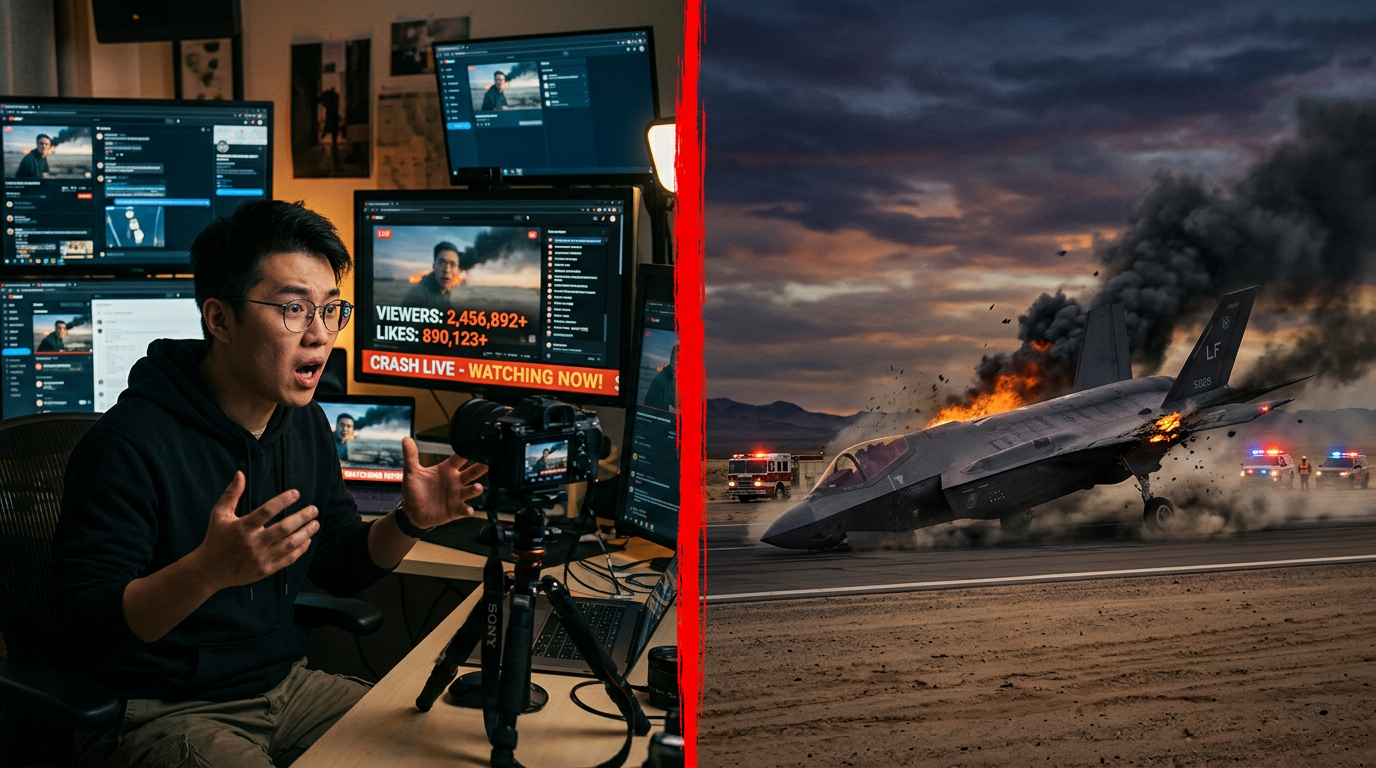
No government order. No military contract. No paycheck.
Just a Chinese engineer, posting videos online for fun —
and five days later, Iran claims it shot down an F-35.
This is the story of how open-source military knowledge
is quietly reshaping modern warfare.
What Happened to the F-35?
On March 19, during ongoing U.S. military operations
against Iran, America’s most advanced stealth fighter —
the F-35 — was hit and forced to make an emergency landing.
Iran’s Revolutionary Guard (IRGC) claims it shot the
aircraft down using a new air defense system.
The U.S. acknowledges the emergency landing but denies
the plane was shot down.
Both sides are spinning the story. But the more
interesting question isn’t who’s telling the truth —
it’s how Iran may have learned to target the F-35 in the first place.

A Chinese YouTuber’s Video — Then Five Days Later
On March 14 — five days before the F-35 incident —
a detailed video appeared on Chinese social media
explaining exactly how Iran could use cheap,
low-cost systems to target and destroy advanced
stealth aircraft like the F-35.
The video was produced by an account called
“Laohu Talks World.” It came with Persian subtitles.
It racked up tens of millions of views.
Five days later, Iran announced it had struck an F-35.
The Hong Kong-based South China Morning Post,
which first reported this connection, described it
as a “remarkable phenomenon” — technically skilled
Chinese civilians voluntarily sharing military
expertise online to help Iran counter U.S. military power.
No money exchanged. No government directive.
Just personal belief and, according to one source
close to the channel’s founder, “he’s doing it just for fun.”
Who Is “Laohu”?
The founder of the Laohu account reportedly studied
at Northwestern Polytechnical University (NPU) —
one of China’s top defense research institutions,
and an entity already under U.S. sanctions since 2001.
Sources say many NPU alumni who contribute similar
content work in China’s military and defense industries.
But critically — their contributions appear to be
personal, not institutional. Motivated by ideology
and interest, not profit or orders.
This Is Just the Tip of the Iceberg
The Laohu video is one example of a much broader trend
SCMP documented across Chinese social media during
the Iran conflict:
- GPS coordinates of U.S. military bases shared publicly
- Missile strike strategies against U.S. aircraft
carriers in the Persian Gulf - Defense simulations for Kharg Island —
a potential U.S. ground invasion target
All of it freely available. All of it created by
civilians with STEM backgrounds.

The Numbers Behind China’s STEM Army
Here’s the scale of what America is up against:
- China graduates approximately 5 million STEM students
per year - Around 1.3 million of those are engineers
- The U.S. graduates roughly 130,000 engineers annually
That’s 10 times the engineering talent pool —
and a significant portion of them are apparently
willing to share military-relevant knowledge online,
for free, in their spare time.
What This Means for Modern Warfare
This is asymmetric warfare in its most unexpected form.
Not drones. Not missiles. Not cyberattacks.
A guy with an engineering degree, a camera, and a
social media account — posting tutorials on how to
shoot down a $100 million stealth jet.
The F-35 cost billions to develop. The knowledge
that may have helped bring one down? Free. Online.
Available to anyone with an internet connection.
Is this the future of warfare — open-source military knowledge shared freely online? Or should platforms be doing more to stop this? Tell us what you think in the comments. 👇
1 thought on “China’s Anonymous Civilians Just Helped Iran Shoot Down America’s Most Advanced Fighter Jet”