
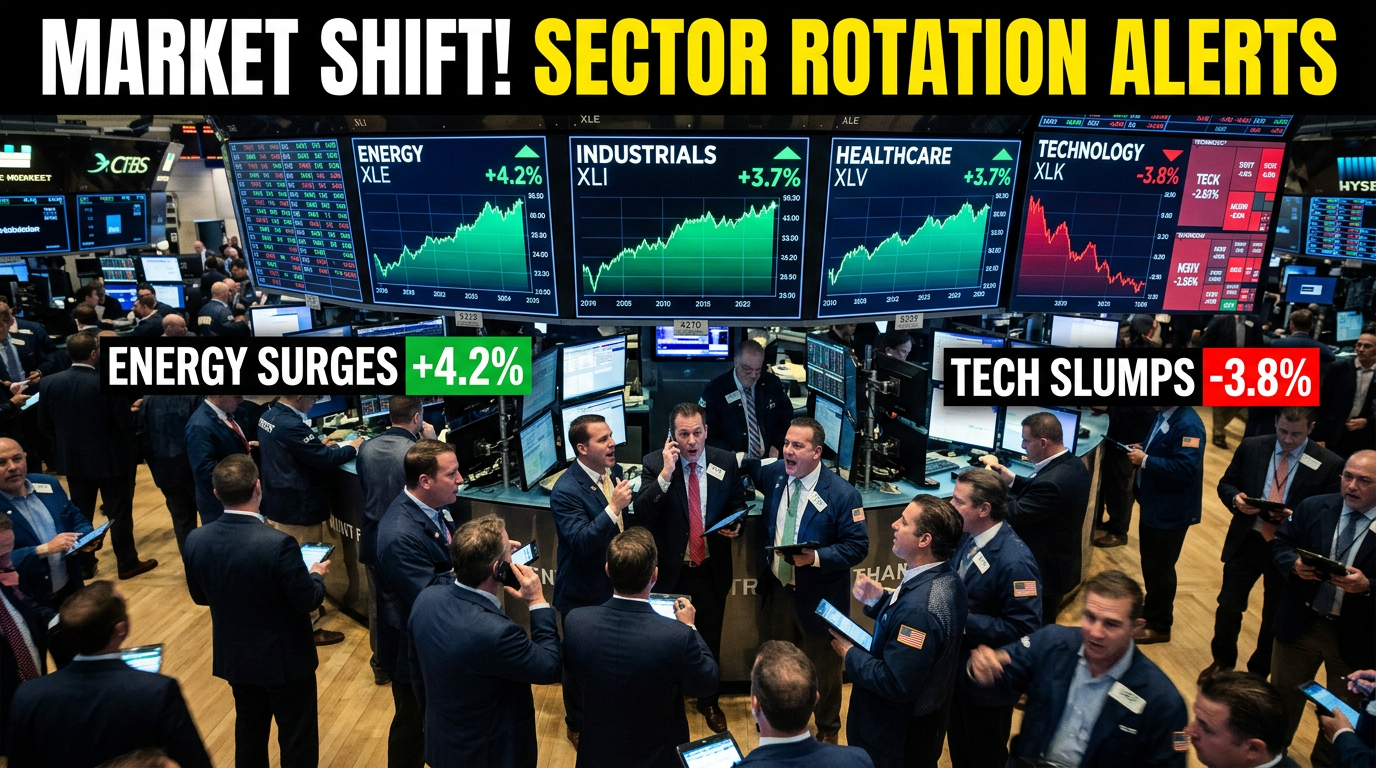
For the past three years, investing in stocks
meant one thing: ride the AI wave.
That trade is getting complicated.
In 2026, the smartest money on Wall Street
is quietly rotating into sectors that
most retail investors are still ignoring.
Here’s what the data shows —
and where attention is shifting.
What’s Actually Happening in 2026
Industrial, consumer defensive, and energy stocks
are leading the stock market higher in 2026
as technology names falter and investors look
beyond the AI trade for returns.
This is called a sector rotation —
and it’s one of the most significant
market shifts since the AI boom began.
If 2025 was a year of mega caps and momentum,
2026 begins with refrains of reversal,
rotation and recalibration.
Here are the five sectors drawing the most
attention from individual investors right now.
1. Energy — The Surprise Leader of 2026
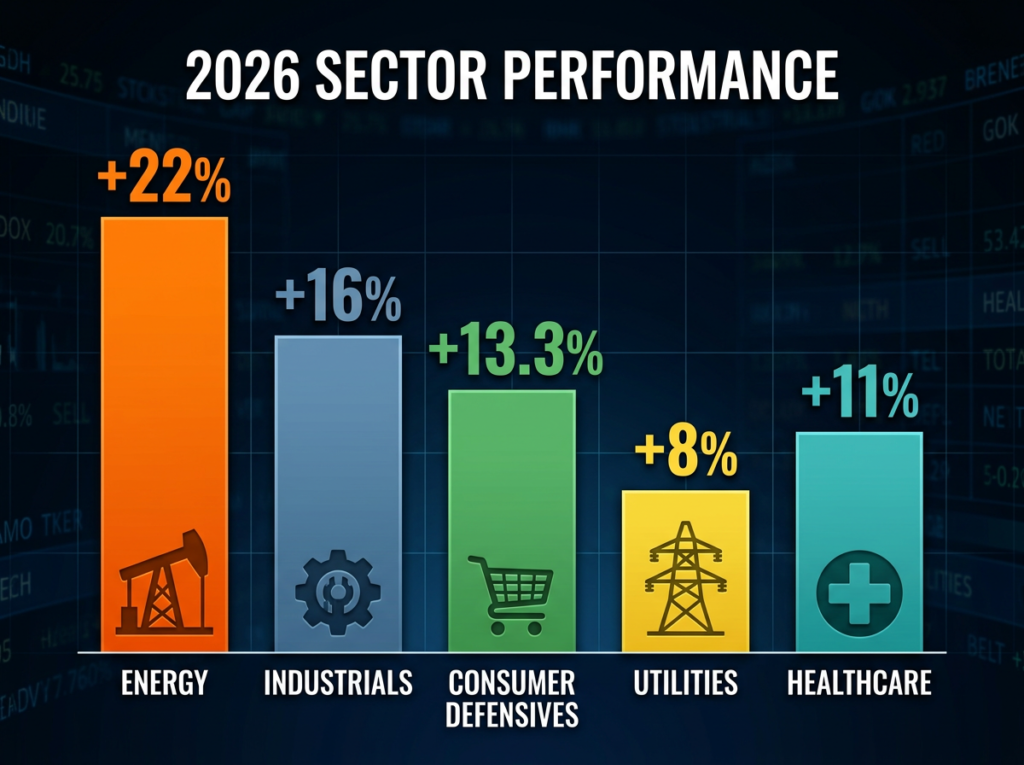
Energy stocks have seen dramatic gains
and are up more than 22% since the start of the year.
The drivers are straightforward:
- Rising oil prices amid Middle East tensions
- AI data centers consuming unprecedented
amounts of electricity - Ongoing global energy transition investment
Within energy stocks, oil giants Exxon Mobil
and Chevron have had the biggest impact.
The Iran conflict — now in its third month —
is keeping energy prices elevated and
energy stocks in focus for investors
seeking both growth and inflation protection.
2. Industrials — Quietly Up 16%
Industrial stocks have gained more than 16%
so far in 2026, with Caterpillar acting
as the largest contributor.
The thesis: AI needs physical infrastructure.
Data centers require construction,
power equipment, and industrial machinery.
The companies building the AI economy —
not just the software companies running it —
are benefiting enormously.
Industrials are expected to have another
strong year in 2026 as infrastructure demand
of all types is likely to get a boost
if lower rates spur capital expenditures.
3. Consumer Defensives — Safety in Uncertain Times
With consumer spending slowing and many
American households shifting toward more
economical options at the grocery store,
investors have turned to consumer defensive stocks.
Walmart’s 13.7% return accounts for
2.3 percentage points of the sector’s 13.3% gain
for the year. Costco is up 15.7% over the same period.
When economies get shaky, people still buy
groceries, household goods, and staples.
That’s the defensive investor’s logic —
and in 2026, it’s working.
4. Utilities — The Hidden AI Play
Most people don’t think of utility companies
as tech investments.
They should.
Domestic-focused power infrastructure and
solar players can benefit from structural
growth drivers like AI data center expansion,
industrial expansion, and the energy transition.
AI data centers consume enormous amounts
of electricity. Every new data center built
by Amazon, Microsoft, or Google means more
demand for power — and more revenue for
the utilities providing it.
Utilities stocks are expected to benefit
from increased demand from data centers,
as well as the need to update aging
electric infrastructure.
5. Healthcare — The Overlooked Comeback
The healthcare sector has underperformed
the S&P 500 by a wide margin over the
last 2.5 years. While the broader market
increased by about 87% since 2020,
the healthcare sector has delivered only 27%.
That underperformance is creating opportunity.
When comparing price-to-book ratios to
expected return on equity, most healthcare
sectors are cheap. The healthcare sector
has not traded at a premium to the S&P 500
since the early 2000s.
The catalyst: GLP-1 drugs (Ozempic, Wegovy)
are reshaping the entire healthcare industry,
and AI is beginning to transform drug discovery,
diagnostics, and hospital operations.
Unclear US government policy direction
clouded the health care sector’s outlook
in 2025 and may continue to do so in 2026 —
making it volatile, but potentially rewarding
for patient investors.
What About AI Stocks?
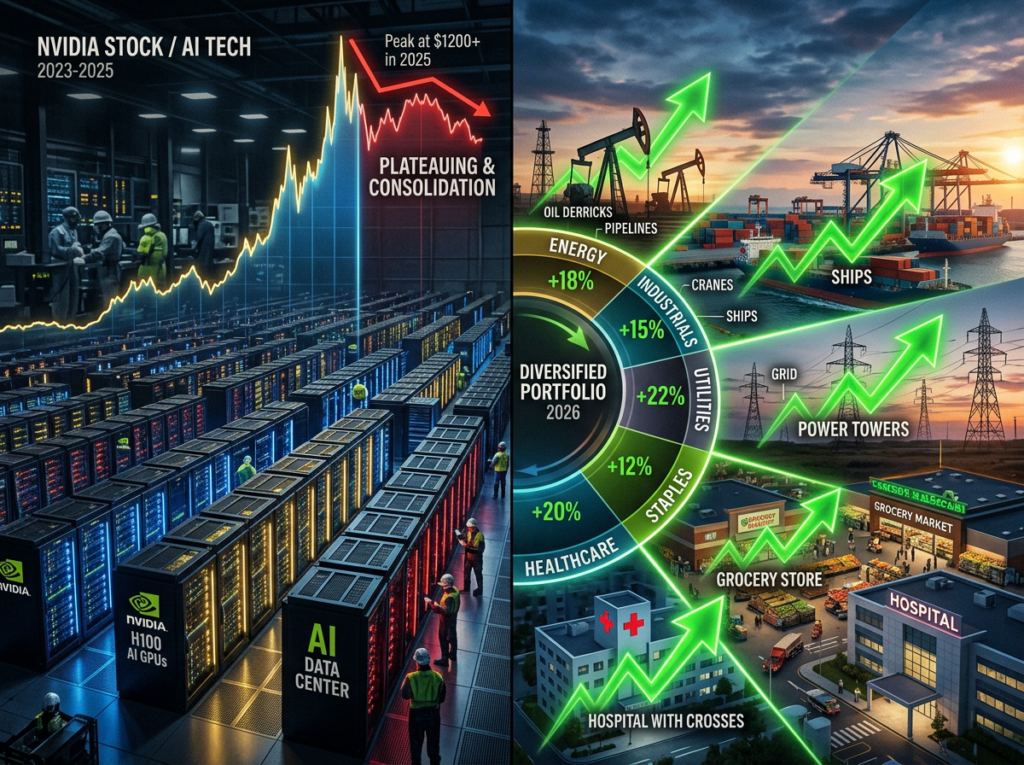
AI isn’t going away. Far from it.
AI stocks grew earnings markedly faster
than their non-AI counterparts since
ChatGPT was released: the 46 stocks in
the S&P index identified as AI stocks
grew their aggregate net income by 30%
per year from 2023–2025, versus just 3%
for the non-AI cohort.
But the easy money has been made.
The stocks are no longer cheap.
And the rotation suggests investors
are diversifying away from concentration risk.
The 10 largest companies in the S&P 500
now constitute over 40% of the index market cap.
That concentration is exactly why smart
money is looking elsewhere.
The Big Picture
The market is likely going to continue
to experience ongoing sector rotations,
with artificial intelligence in the spotlight
amid concerns about circular financing
and capex sustainability.
The summary for 2026:
| Sector | 2026 Performance | Key Driver |
|---|---|---|
| Energy | +22% | Oil prices, AI power demand |
| Industrials | +16% | Infrastructure, AI buildout |
| Consumer Defensives | +13.3% | Economic uncertainty |
| Utilities | Positive | Data center electricity demand |
| Healthcare | Recovering | GLP-1 drugs, AI in medicine |
⚠️ Disclaimer: This article is for
informational purposes only and does not
constitute investment advice.
All investing involves risk, including
possible loss of principal.
Please consult a financial advisor before
making investment decisions.
Which sector are you most interested in for 2026? Are you rotating away from AI stocks — or staying the course? Tell us in the comments. 👇