
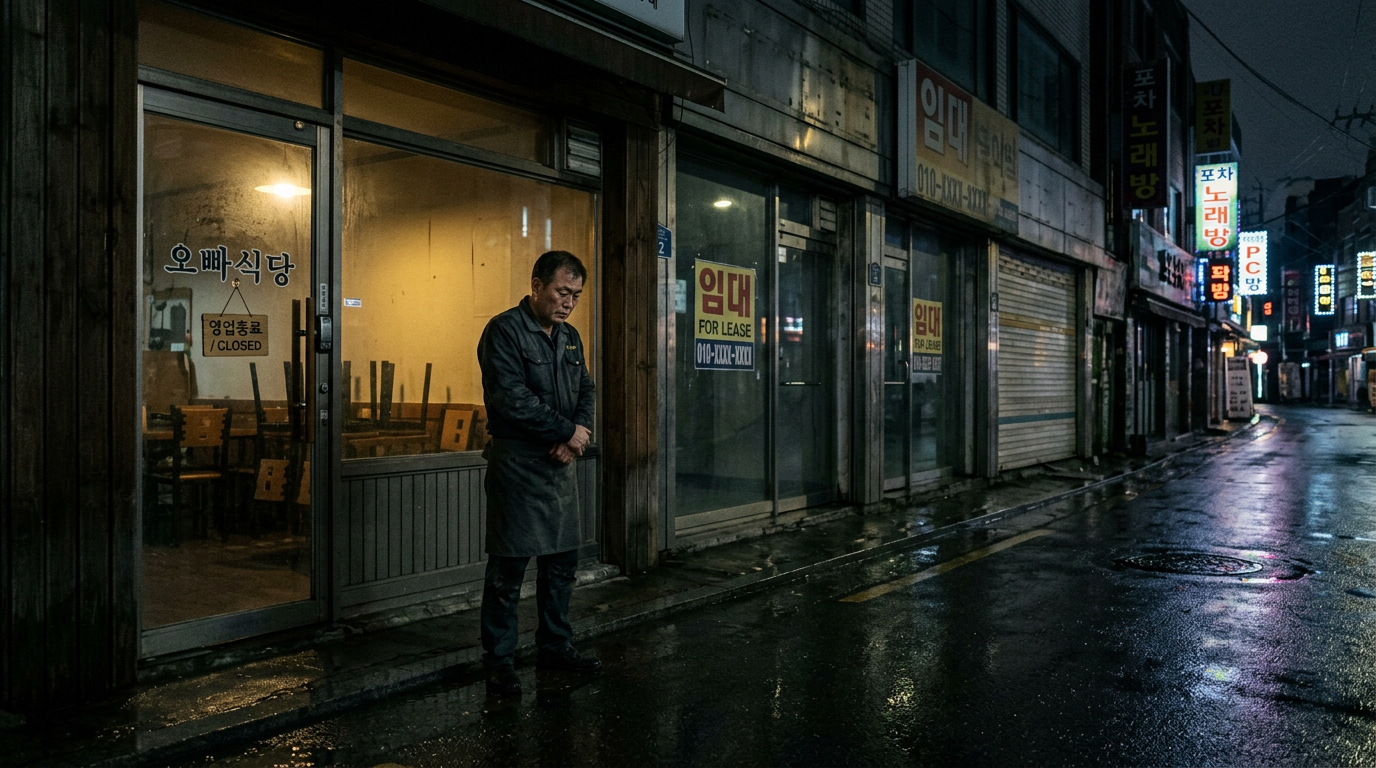
Imagine running a business that’s losing money
every single month.
You want to close. You need to close.
But the cost of shutting down is so high
that you simply can’t afford to quit.
This is the reality for hundreds of thousands
of small business owners across South Korea
in 2026 — and the numbers tell a devastating story.
The Numbers Are Shocking
South Korea’s small business sector
is experiencing a historic collapse.
In Seoul alone:
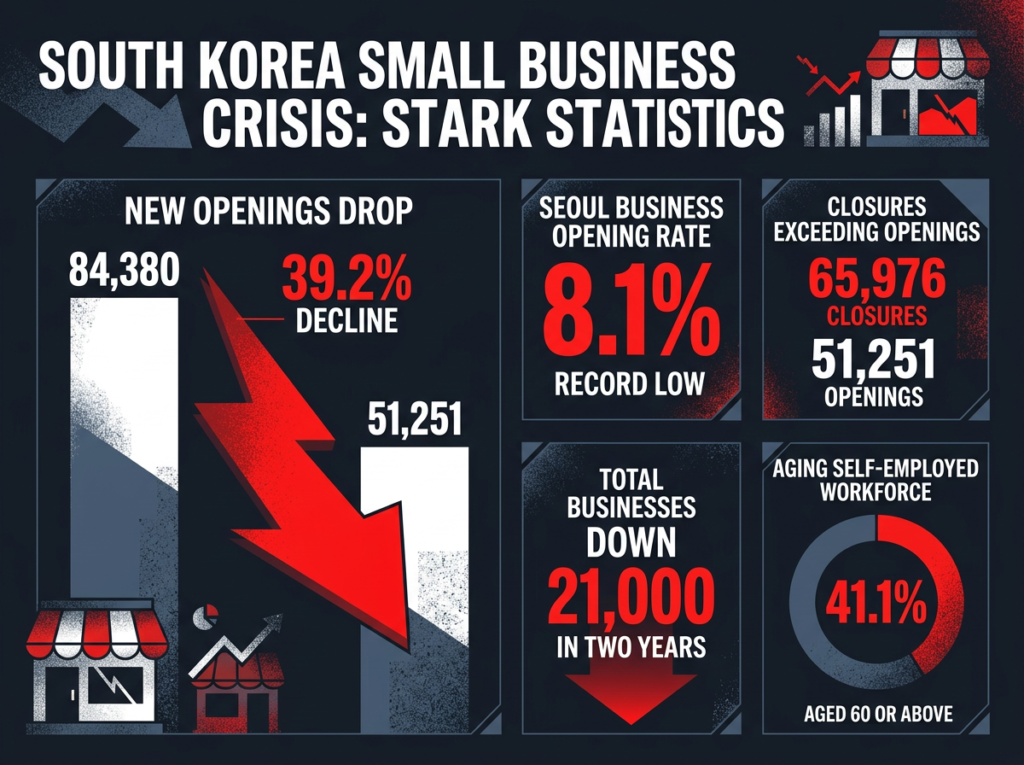
- The business opening rate in 2025 fell to 8.1% —
the lowest since records began in 2017 - New store openings: 51,251 — a record low
- That’s down 39.2% from just two years earlier
(84,380 in 2023) - Closures: 65,976 — far exceeding new openings
- Total stores in Seoul: down from 264,967 to 243,677
in just two years — over 21,000 businesses gone
Why Owners Can’t Even Afford to Quit
Here’s the detail that makes this crisis
uniquely cruel.
Business owner B, who runs a screen golf range,
put it bluntly:
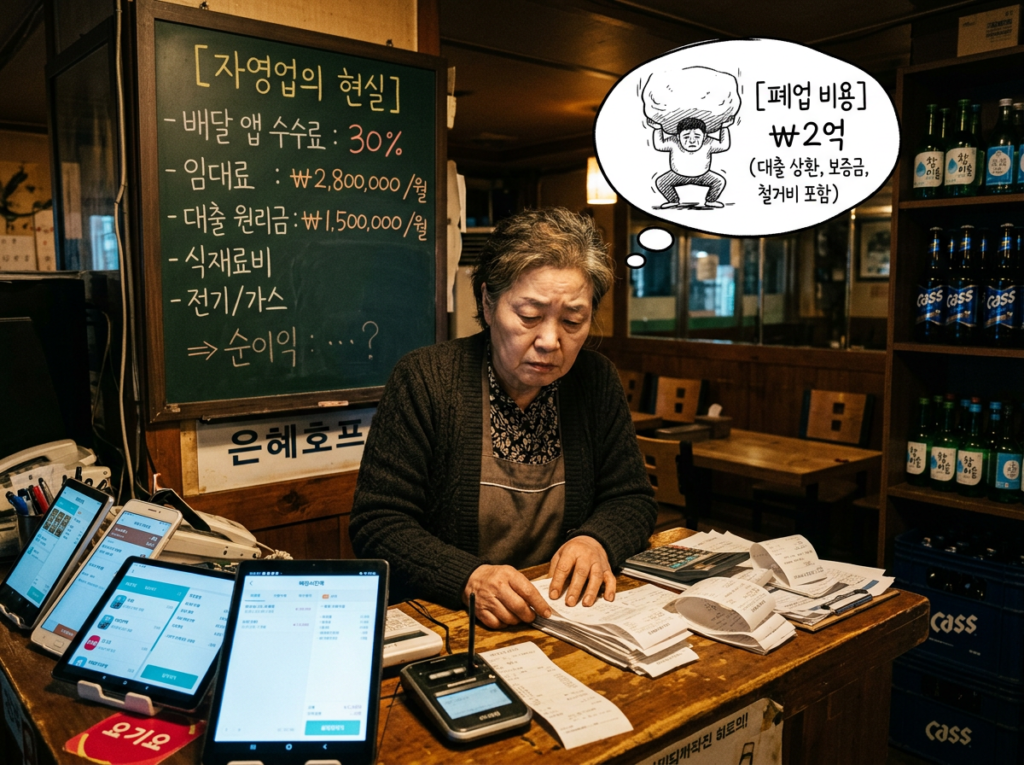
“It costs around 200 million won (approximately
$140,000) just to close down. I’m operating
at a loss, but I just keep going.”
The costs of closure in South Korea include:
- Repaying business loans in full, immediately
- Building demolition and restoration costs
- Lease termination penalties
- Equipment removal costs
For many owners — especially older entrepreneurs
who took out significant loans to open —
the cost of closing exceeds what they could
ever repay. So they keep the lights on,
even as money drains away.
Who Is Being Hit Hardest
The crisis is disproportionately falling
on older Koreans.
41.1% of all self-employed workers in Korea are now aged 60 or above — a record high.
While every other age group is leaving
self-employment, the 60+ group grew by
80,000 people last year.
Why? Because they have nowhere else to go.
A survey of 3,000 self-employed Koreans
found that among those in their 60s:
- 41.5% started a business for survival income
- 39.1% did so after losing a job or to maintain basic living
These aren’t entrepreneurs chasing a dream.
They’re retirees and laid-off workers
with no other options —
opening restaurants and convenience stores
as a last resort.
The Sectors Collapsing Fastest
The businesses disappearing most quickly
are neighborhood staples.
Bars and casual pubs (호프집):
- Annual new openings: from 2,951 (2020)
to just 1,525 (2025) — cut in half in five years - Total bars in Seoul: down 13.2% since 2020
The causes: economic slowdown,
the rise of drinking alone at home (“혼술” culture),
fewer corporate dinner events,
and the brutal economics of delivery apps.
Business owner F, who runs a pub,
described the math:
“Delivery app commissions, advertising fees,
and delivery costs combined take about 30%
of my revenue. Platform fees are as high
as my rent. I’ve taken out cash advances
of up to 50 million won.”
The Structural Problem Nobody Is Solving
Experts say this isn’t just a temporary recession.
A survey of self-employed Koreans found
their top external business challenges:
- 77.6%: Consumer spending shrinkage from recession
- 44.8%: Spread of online platforms
- 41.8%: Weakening of local commercial districts
Professor Lee Eun-hee of Inha University
warned: “If this trend continues,
the collapse of neighborhood commercial districts
cannot be ruled out.”
What This Means
South Korea’s neighborhood economy —
the restaurants, cafes, convenience stores,
and small shops that define Korean urban life —
is contracting at a rate not seen in a generation.
The safety net for these businesses,
the “Yellow Umbrella” closure insurance fund,
paid out a record 1.485 trillion won ($1.05 billion)
last year — up 64.3% from 2021.
That’s a billion dollars in insurance payouts
to businesses that no longer exist.
And for every business that claimed insurance,
there are many more still open, still losing money,
still unable to afford to close.
Do you think governments should do more to support small business owners? Or is the shift toward online platforms simply inevitable? Tell us in the comments. 👇