
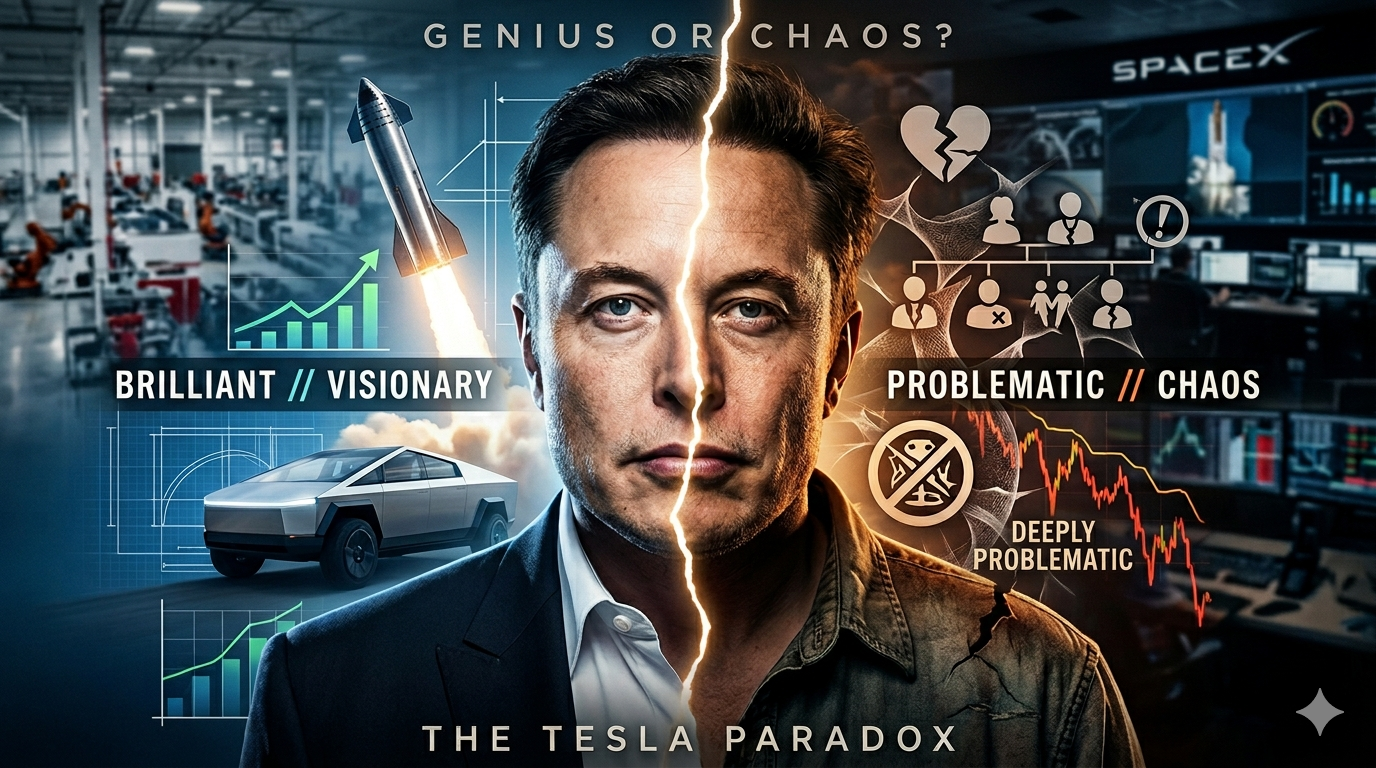
Walter Isaacson spent years following Elon Musk
for his biography. He watched him up close —
in boardrooms, on factory floors, in private moments.
His conclusion?
“From a distance, he’s brilliant.
Up close, he’s deeply problematic.”
And for anyone who owns — or is thinking about
owning — Tesla stock, that paradox is the only
thing that actually matters.
The Man Who Built the Future by Breaking Everything
Musk’s track record is undeniable.
In 2018, Wall Street declared that producing
5,000 Model 3s per week was physically impossible.
Musk erected a giant tent in the factory parking lot,
built a new production line in two weeks,
and hit the target.
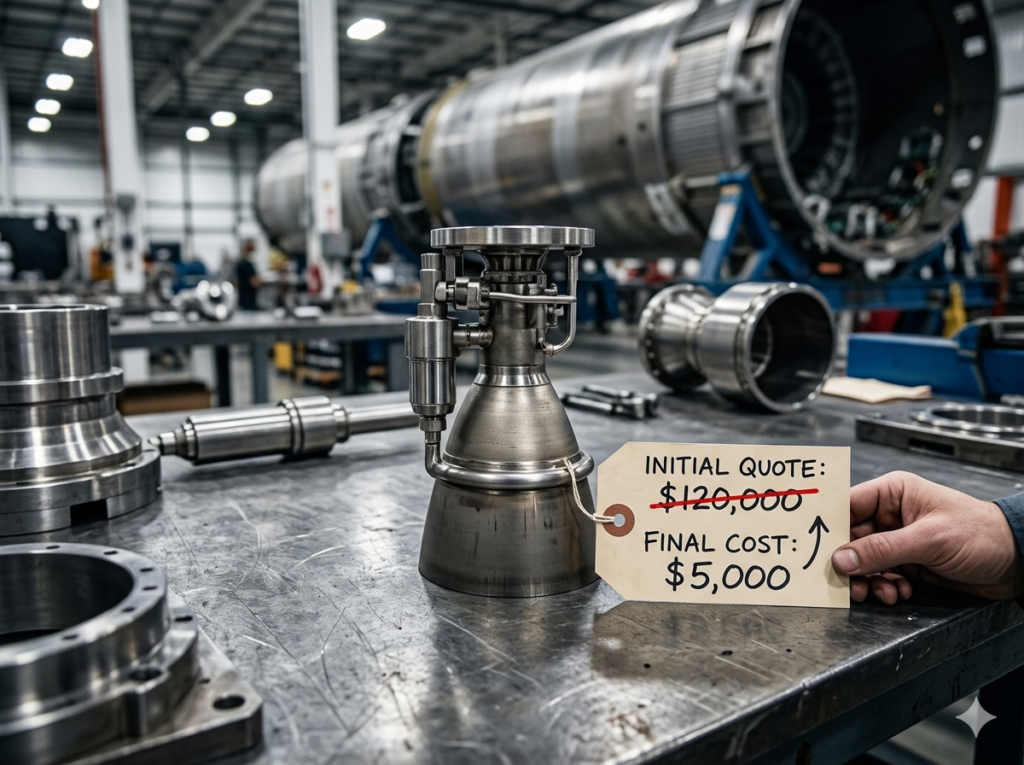
When a supplier quoted $120,000 for an engine
nozzle actuator, Musk told his engineers
to build it for $5,000.
They did.
This is the pattern. Impossible deadlines.
Insane cost targets. A refusal to accept
that physical or economic constraints apply to him.
It’s how SpaceX and Tesla got where they are today.
The Other Side of the Coin
But here’s what the same biography reveals.
Gwynne Shotwell — Musk’s closest colleague
and SpaceX President — describes his empathy gap precisely:
“Elon understands other people’s personalities,
but he learned it intellectually, not by feeling it.
He simply doesn’t think about the impact
his words have on others.
He just wants the mission completed.”
The consequences are real:
His transgender daughter legally cut ties
with him the moment she turned 18, stating
she wants no relationship with her biological father.
His partner Grimes discovered — through reading
the biography — that Musk had secretly fathered
twins with a colleague while they were together.
The same drive that’s pushing humanity toward Mars
is leaving wreckage among the humans closest to him.
The Investment Question
So what does any of this mean for Tesla investors?
Isaacson frames it directly in the book:
“If the price of extraordinary achievement
is having a genuinely difficult person as your leader,
that may be worth it.”
The translation for investors:
the volatility, the erratic tweets,
the regulatory battles, the unpredictable behavior —
these aren’t bugs in the Musk operating system.
They’re features. Inseparable from the performance.
Steve Wozniak said it about Steve Jobs:
“If I had been running Apple,
we would never have built the Macintosh.”
The same logic applies to Musk and Tesla.
The Two Types of Tesla Investors
There are only two rational positions on Tesla:
Position 1 — Accept the package
You understand that Musk’s chaos and his genius
are the same thing. You buy the volatility
as the price of admission.
You hold through the swings because
you believe in the destination.
Position 2 — Walk away
You recognize that you can’t stomach the ride.
You choose not to invest —
and that’s a completely legitimate choice.
What doesn’t work is Position 3:
buying Tesla because you love the cars or admire
the mission, while being shocked and panic-selling
every time Musk does something unpredictable.
That’s how investors buy high and sell low.
Over and over again.

Musk Said It Best Himself
At Tesla’s 2019 annual meeting,
a shareholder challenged him on
missed self-driving timelines.
Musk smiled and responded:
“Yes, I’m sometimes too optimistic about timeframes.
But if I weren’t optimistic,
would I even be doing this?”
The crowd applauded. They got it.
As Isaacson puts it: Musk’s flaws and strengths
are woven into the same fabric.
You can’t pull out only the dark threads
without unraveling the whole cloth.
The question every Tesla investor must answer
is simple — and Musk himself framed it perfectly:
“If I’ve offended anyone, I’d just like to say:
I reinvented the electric car and I’m sending
people to Mars on a rocket ship.
Did you think I was also going to be
a chill, normal dude?”
Are you a Tesla investor — and does Musk’s behavior affect your conviction? Or do you see the chaos as part of the deal? Tell us in the comments. 👇