
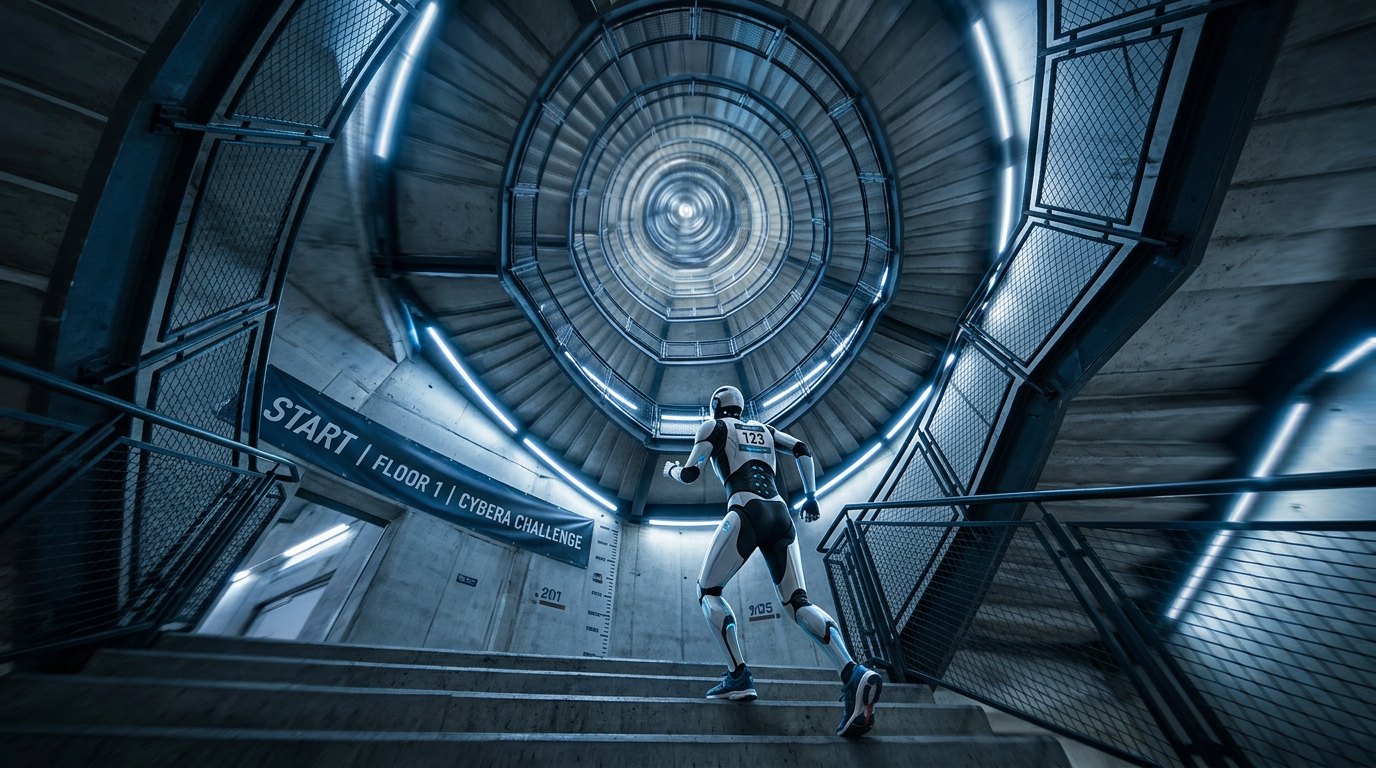
Every April, hundreds of athletes gather at the
base of Lotte World Tower in Seoul —
555 meters tall, 123 floors —
and race each other to the top.
2,917 stairs. Straight up.
This year, one of the competitors doesn’t have lungs.
Meet ROI — The Steel Marathon Runner
ROI is a Unitree G1 humanoid robot,
manufactured in China.
Its name stands for “Robot Innovation.”
It wears running crew gear.
And on April 18, it will attempt to climb
all 2,917 stairs of Lotte World Tower.
ROI has been trained for the past year by
Lotte Innovate — the tech arm of South Korea’s
Lotte Group, driving the conglomerate’s
adoption of physical AI.
“ROI can climb and descend stairs at a speed
similar to an adult human,” said Jeon Bong-ji,
AI Technology Team Leader at Lotte Innovate.
What Makes This So Hard for a Robot
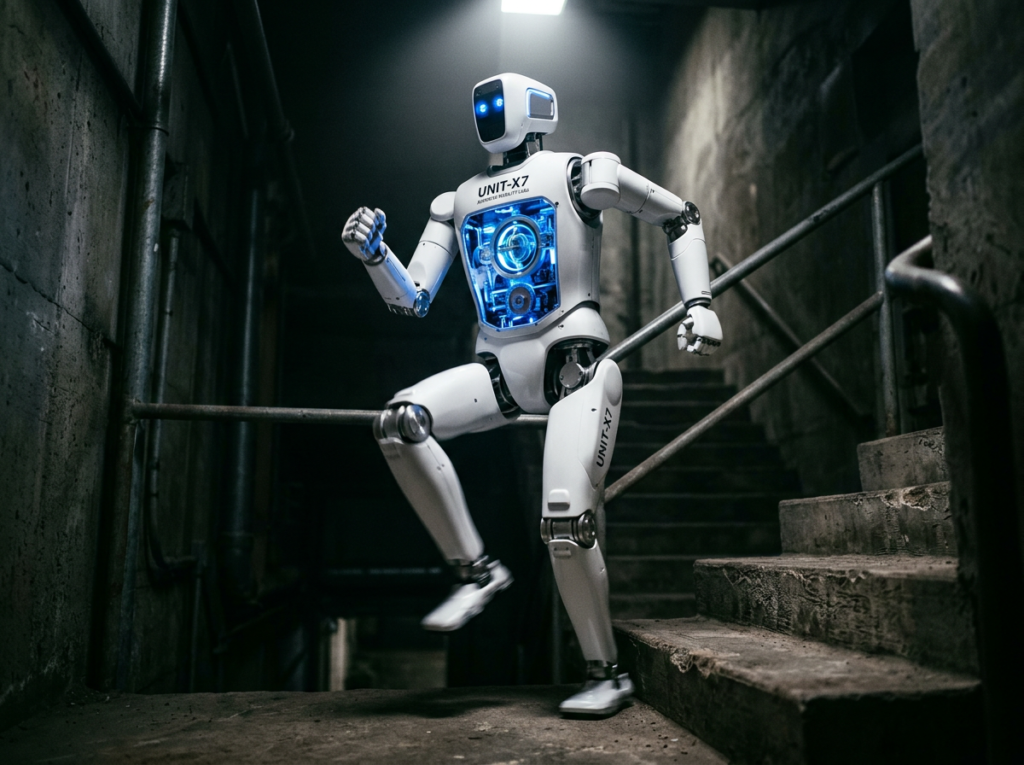
Climbing stairs sounds simple. For a robot,
it’s an engineering nightmare.
Seoul National University professor Cho Gyu-jin,
an expert in robot control, explains:
“For a robot to walk on stairs, it must maintain
precise balance at all times. It also needs
advanced learning capabilities to instantly
recover its posture when its foot catches on a step.”
Think about what your body does automatically
when you misjudge a step — the lightning-fast
micro-adjustments that prevent you from falling.
For a robot, every single one of those adjustments
must be calculated, predicted, and executed
in real time. At speed. For 2,917 consecutive stairs.
Last year’s human winner completed the course
in 18 minutes and 32 seconds.
ROI won’t be racing against the humans directly —
it will run the course the day before the event
on April 18, with the actual competition on April 19.
Battery efficiency and safety routing were factors.
On race day itself, ROI will make a surprise
appearance at the awards ceremony and
demonstrate various movements in front of participants.
The Uncomfortable Question Nobody Wants to Ask
Here’s where the story gets interesting.
Why is a South Korean conglomerate —
one of the country’s biggest corporations —
using a Chinese robot for this event?
Lotte didn’t choose China by preference.
The company first searched dozens of domestic
Korean robot manufacturers looking for a robot
that could participate in the Skyrn.
They couldn’t find one.
An industry insider put it bluntly:
“There is no mass-produced Korean robot that
is as versatile as the Unitree G1,
while also being able to walk and run well.”
Lotte couldn’t even find a domestically
produced robot that could simply stand
upright on two legs reliably.
The Bigger Picture: China’s Robot Lead
Unitree has become one of the most talked-about
robotics companies in the world.
The G1 has previously demonstrated tumbling,
boxing, and complex physical tasks that shocked
robotics experts globally.
Now it’s entering marathon competitions.
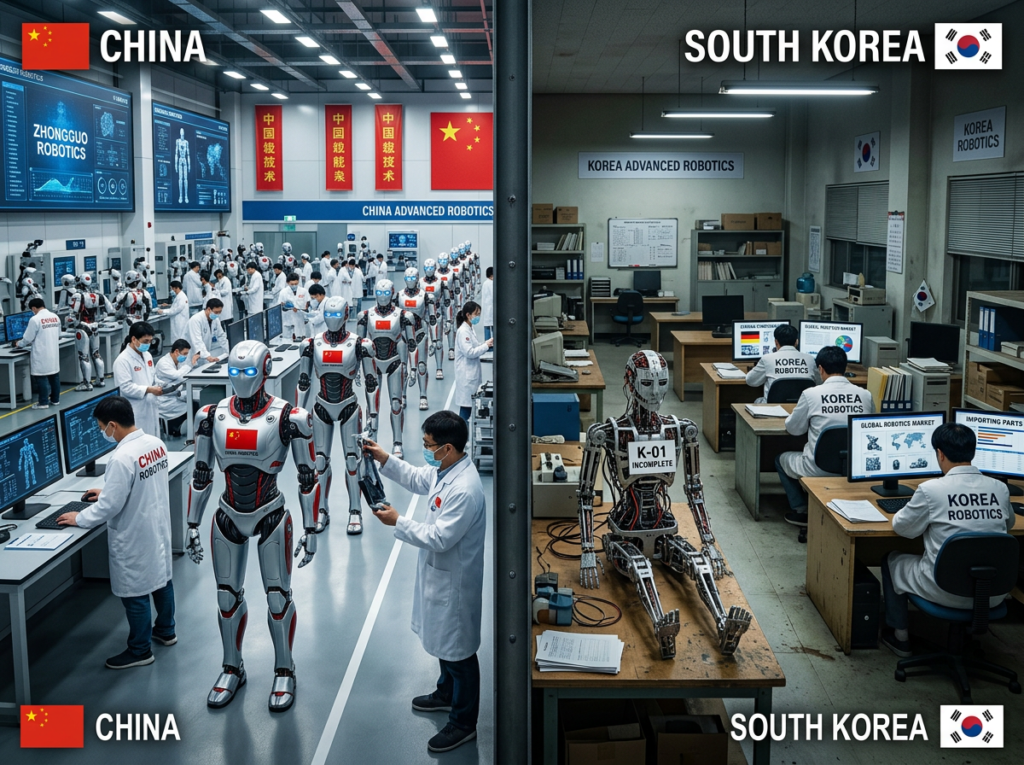
China’s investment in humanoid robotics has
been massive, state-backed, and relentless.
The results are increasingly visible —
not just in labs, but in real-world deployments
at public events.
South Korea, home to Samsung, Hyundai, and LG —
companies at the cutting edge of technology —
is finding itself searching Chinese catalogs
for robots that can simply climb stairs.
What This Means
The race up Lotte World Tower on April 18
is more than a publicity stunt.
It’s a snapshot of where humanoid robotics
actually stands right now — and which country
is leading the charge.
Last year’s winner: a human, 18 minutes 32 seconds.
This year’s wildcard: a Chinese robot,
training completed, ready to climb.
The real competition isn’t happening on the stairs.
It’s happening in the labs, factories, and
government funding offices of Beijing,
Seoul, Boston, and Tokyo.
And right now, one country has a very clear lead.
Do you think humanoid robots will eventually outcompete humans in physical tasks? And should South Korea be worried about falling behind China in robotics? Tell us in the comments. 👇