

For decades, managing diabetes meant one thing:
control your blood sugar.
That’s no longer enough.
South Korean medical experts and global diabetes
guidelines are now warning that blood sugar control
alone is dangerously incomplete — and the treatment
approach is undergoing its biggest overhaul in decades.
The Scale of the Problem
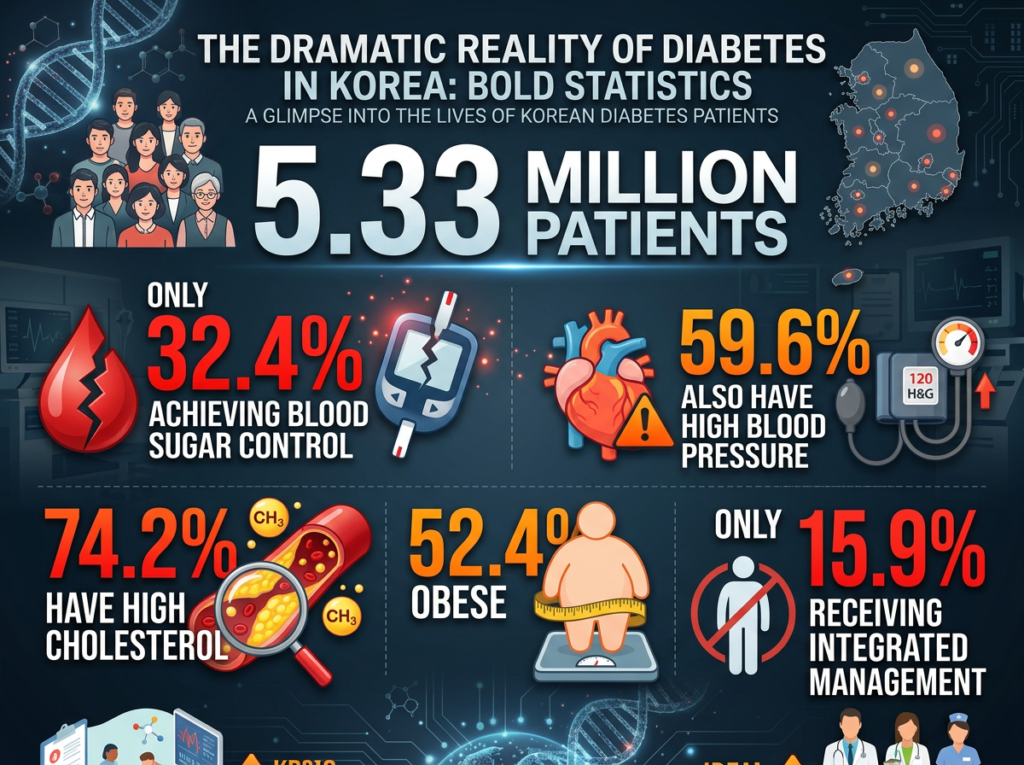
South Korea has approximately 5.33 million diabetes patients aged 30 and over,
with another 14 million in the pre-diabetic stage.
The awareness rate is relatively high at 74.7% —
meaning most people know they have it.
But here’s the alarming gap:
Only 32.4% of diabetes patients
are achieving adequate blood sugar control
(HbA1c below 6.5%).
That means roughly 2 in 3 diabetes patients
are not properly controlled —
despite knowing they have the disease.
It’s Not Just Blood Sugar
Here’s what most people don’t realize
about diabetes.
The disease doesn’t stay in your blood.
Chronically elevated blood sugar attacks
virtually every organ system in your body:
- Cardiovascular disease
- Kidney failure
- Nerve damage
- Retinal damage (blindness)
- Increased stroke risk
And the numbers tell a stark story
about what happens when diabetes patients
aren’t comprehensively managed:
Among Korean diabetes patients:
- 59.6% also have high blood pressure
- 74.2% have high cholesterol
- 52.4% are obese
Their mortality risk is 1.55 times higher
than people without diabetes.
The Hidden Crisis: Integrated Management
Managing blood sugar, blood pressure,
cholesterol, and weight simultaneously
is called “integrated management” —
and it’s considered the gold standard.
The current rate of integrated management
among Korean diabetes patients?
15.9%.
Less than 1 in 6 patients is receiving
the comprehensive care they need.
The consequences are severe.
Professor Ryu Young-sang of Chosun University
Hospital warned that complications from
inadequately managed diabetes can increase
a patient’s direct medical costs
by up to 79 times.
Patients with complications face
1.5 to 3 times higher risk of
reduced quality of life compared to
those without complications.
The Treatment Guidelines Just Changed
In 2025, the Korean Diabetes Association
made a landmark decision:
Metformin — the oral medication that has been the first-line treatment for Type 2 diabetes for decades — was removed from the primary treatment recommendation.
This aligns South Korea with major international
guidelines from the American Diabetes Association,
the European Association for the Study of Diabetes,
and the European Society of Cardiology.
The new approach prioritizes:
GLP-1 Receptor Agonists
These medications mimic a natural hormone
(GLP-1) released after eating, stimulating
insulin production while suppressing glucagon
— lowering blood sugar more naturally and
effectively than older medications.
This is the same class of drugs as Ozempic
and Wegovy — which have made headlines globally
for their dramatic effects on blood sugar
and weight loss.
The new guidelines recommend GLP-1 receptor
agonists be prioritized over basal insulin
in cases requiring aggressive blood sugar control.

What “Comprehensive Management” Actually Means
The new treatment paradigm isn’t just about
a different pill.
It’s about treating the whole patient —
not just the number on a glucose meter.
Modern diabetes management now targets:
- Blood sugar (HbA1c below 6.5%)
- Body weight (obesity is both a cause and complication)
- Blood pressure (present in 60% of patients)
- Cholesterol (present in 74% of patients)
- Organ protection (kidneys, heart, eyes, nerves)
Professor Cho Yun-kyung of Asan Medical Center
summarized the shift:
“We need to consider comprehensive,
patient-centered approaches that integrate
management of blood sugar, body weight,
and cardiovascular risk factors —
not treat them separately.”
What This Means for You
If you or a family member has Type 2 diabetes,
here are the questions worth asking your doctor:
1. Am I being treated for complications — not just blood sugar?
Many patients are on blood sugar medication
but have unmanaged blood pressure or cholesterol.
2. Has my treatment plan been updated recently?
Guidelines changed significantly in 2025.
Older treatment plans may not reflect
current best practices.
3. Should I be on a GLP-1 receptor agonist?
These medications (including Ozempic-class drugs)
are now preferred in many cases over
traditional insulin injections.
4. What is my HbA1c — and is it below 6.5%?
This is the key blood sugar control metric.
If your doctor hasn’t mentioned this number,
ask about it.
Do you or someone you know have diabetes? Has your treatment approach changed recently? Tell us in the comments. 👇