

A new national survey of 5,275 young Americans
just confirmed what millions of people
already suspected:
Dating is broken. And it’s getting worse.
The 2026 State of Our Unions report —
based on the 2025 National Dating Landscape Survey —
paints a stark picture of young adults
stuck between wanting love and being unable to find it.
Only 1 in 3 Young Adults Is Actually Dating
Here’s the number that should shock everyone:
Only 30% of young adults reported they are
currently dating — either casually or exclusively.
When asked how often they dated in the past year:
- 74% of women had not dated or dated only
a few times - 64% of men said the same
Yet 51% of respondents said they were single and interested in starting a relationship.
Half of young adults want to be in a relationship.
Only a third are actually trying.
The gap between desire and action
is the heart of the dating recession.
They Want Love — Just Not Casual Sex
Here’s what demolishes the “hookup culture” narrative:
When asked why they date, young adults
overwhelmingly chose traditional reasons:
- 83% of women, 76% of men:
creating emotional connections - 83% of women, 74% of men:
forming serious relationships - 69%: exploring potential romantic partners
- 67%: personal growth
Only 17% said they date to fit in socially.
Only 16% cited social validation.
Young adults aren’t afraid of commitment.
They don’t want casual hookups.
They want real relationships —
and they don’t know how to get them.
The Confidence Crisis
The real culprit? Dating confidence has collapsed.
Only 1 in 3 young adults expressed
faith in their dating skills.
Specifically:
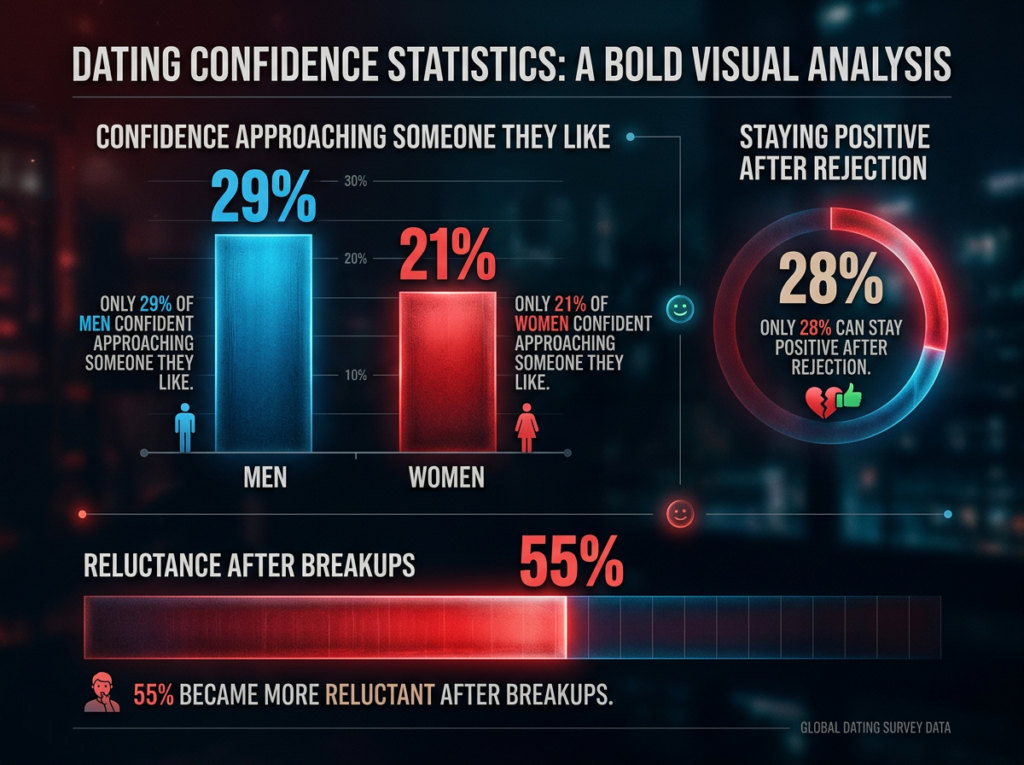
- Only 29% of men and 21% of women
felt confident approaching someone
they were romantically interested in - Only 37% trusted their judgment
in choosing a dating partner - Only 34% felt confident discussing
feelings on a date - Only 36% could pick up on social cues
And perhaps most alarming:
Only 28% of young adults said they
could stay positive after a bad date
or relationship setback.
More than half (55%) said their breakups
made them more reluctant to start new relationships.
Nearly half (45%) said they passed up
opportunities for new relationships
because of past bad experiences.
Money Is the #1 Barrier
The biggest obstacle to dating isn’t fear of commitment.
It’s money.
52% of respondents — 58% of men,
46% of women — said not having enough money
was their primary barrier to dating.
Contemporary dating culture demands expensive
restaurants, concerts, and activities.
Young adults feel priced out of their own love lives.
Other top barriers:
- Lack of confidence: 49%
- Bad past dating experiences: 48%
- Lack of relationship experience: 38%
- Not emotionally ready: 35%
What was NOT a major barrier:
- Fear of losing personal freedom: 27%
- Not wanting to commit long-term: 18%
The narrative that “young people don’t want
commitment” is simply not supported by the data.
The Marital Horizon Problem
Here’s the most unsettling finding.
Young adults who expect to marry were asked
at what age they expected to tie the knot.
The average answer: 5-6 years from now —
regardless of their current age.
A 22-year-old says they’ll marry at 28.
A 29-year-old says they’ll marry at 34-35.
A 33-year-old says they’ll marry at 39.
The horizon keeps moving forward as they age —
rather than getting closer.
Marriage is always an abstract future goal,
never an urgent present priority.
And demographers now estimate that
a third of young adults born in the early 21st century will never marry —
continuing a steady decline since the 1970s.

What’s Actually Driving This?
The researchers point to several culprits:
Dating apps: The infinite swipe creates
“relational consumerism” — treating potential
partners as products to evaluate rather than
people to connect with. Matching, messaging,
meeting, disappointment. Repeat until burned out.
Hookup culture: Young adults hate it —
but feel trapped in it. They want serious
relationships but the cultural infrastructure
for building them has eroded.
Skills gap: Nobody taught this generation
how to date. Schools don’t teach it.
Parents often don’t model it.
The result is a generation that wants
relationships but lacks the basic skills
to build them.
Financial pressure: When a “normal date”
means a nice dinner plus an activity,
young adults living paycheck to paycheck
simply opt out.
Is There a Way Out?
The researchers aren’t without hope.
Their prescription: dating education.
Not relationship counseling. Not marriage prep.
Actual skills-based education on how to approach
someone you like, how to communicate on dates,
how to recover from rejection, and how to
build resilience through the inevitable heartbreaks.
“Dating bootcamps.” Peer educators.
Low-cost date ideas. Online courses.
The underlying message: the desires are there.
The skills are not.
And skills can be taught.
The Bottom Line
Young adults today want exactly what
every generation before them wanted —
love, connection, a serious partner,
eventually a family.
They’re not commitment-phobic.
They’re not obsessed with casual sex.
They’re not anti-marriage.
They’re scared, broke, burned by past
relationships, and nobody ever taught them
how to do this.
Do you think dating is harder now than it was for previous generations? What do you think is the biggest reason young people aren’t dating? Tell us in the comments. 👇