
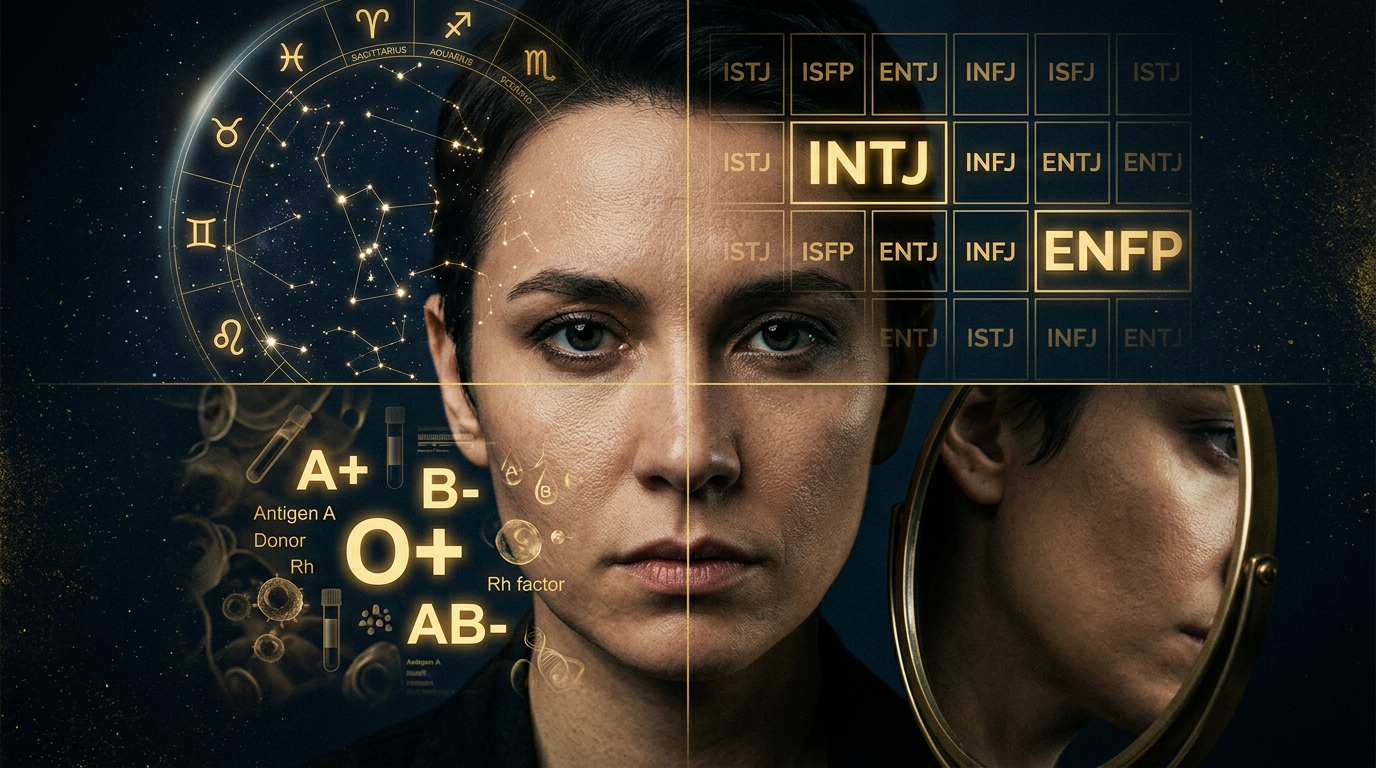
“Are you an INTJ or ENFP?”
“What’s your sign?”
“What blood type are you?”
Billions of people around the world have asked — and
answered — these questions as if the answers reveal
something profound about who they are.
But do they? And if personality typing is scientifically
questionable, why can’t we stop believing in it?
Psychology has some fascinating answers.
The Comfort of Being Categorized
Blood types, zodiac signs, and MBTI all share one
key trait: they take the infinite complexity of human
personality and compress it into a handful of neat,
digestible categories.
This isn’t a bug. It’s the feature.
Human brains are pattern-seeking machines. Faced with
the overwhelming complexity of other people — their
histories, traumas, motivations, contradictions —
we desperately want a shortcut.
“You’re a Scorpio? That explains everything.”
“Oh, you’re a T. That’s why you said that.”
These frameworks give us the illusion of understanding
people quickly. And that feeling is incredibly satisfying.

The Barnum Effect: Why It Always Feels Accurate
In 1948, psychologist Bertram Forer ran a now-famous
experiment. He gave all his students the same generic
personality description and asked them to rate how
accurately it described them personally.
The average rating? 4.26 out of 5.
The catch: every single student received the exact
same text.
This is the Barnum Effect — our tendency to accept
vague, general statements as highly personal and
accurate descriptions of ourselves.
Sound familiar? It’s exactly why your horoscope always
seems to be speaking directly to you.
Confirmation Bias: We Remember What Fits
Even when personality descriptions are wrong, we
rarely notice.
Our brains are wired to seek out information that
confirms what we already believe — and ignore
everything that contradicts it.
If you believe Virgos are detail-oriented, you’ll
remember every time a Virgo friend is meticulous
and forget every time they’re chaotic.
If you think INTJs are cold, you’ll catalog every
moment your INTJ colleague seems distant — and
explain away their warmth as an exception.
The framework shapes what you see, not the other way around.
The Self-Fulfilling Prophecy
Here’s where it gets really interesting.
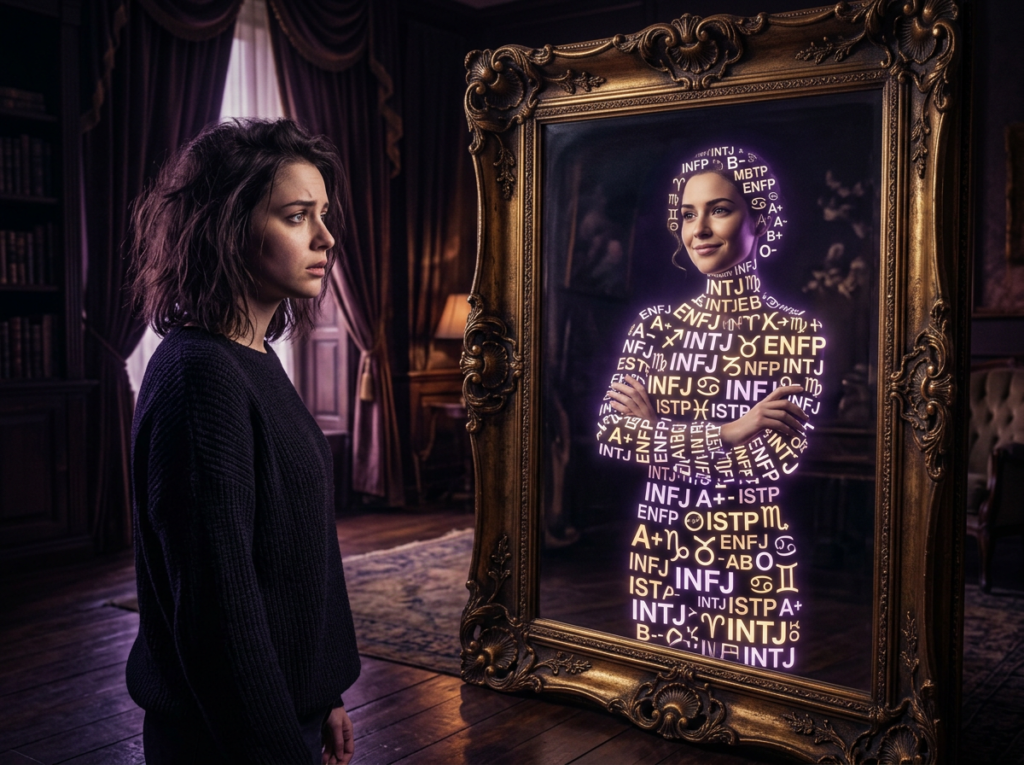
The moment you accept a personality label —
“I’m a T, so I’m logical” — you start behaving
in ways that confirm it.
You lean into logic. You downplay your emotional
responses. You explain away your empathy as
“acting out of character.”
The belief creates the behavior. The behavior
confirms the belief. And eventually, the label
feels indistinguishable from reality.
So Why Do We Keep Using These Systems?
Psychology doesn’t say these systems are entirely
worthless. What researchers argue is that their
value lies in self-reflection, not scientific prediction.
MBTI, zodiac signs, and blood types are useful as:
- Conversation starters — breaking the ice with strangers
- Self-exploration tools — prompting you to think about your tendencies
- Social bonding — shared frameworks create shared identity
Where they fall short: predicting behavior, diagnosing
personality, or making important decisions about people.
The Real Question
You’ve taken the MBTI test. You know your sign.
Maybe you even believe certain blood types are
more compatible with yours.
But here’s what psychology actually wants you to ask:
Is the label describing who you are — or telling
you who to become?
Are you an MBTI believer or a skeptic? What’s your type — and do you think it actually fits you? Tell us in the comments. 👇